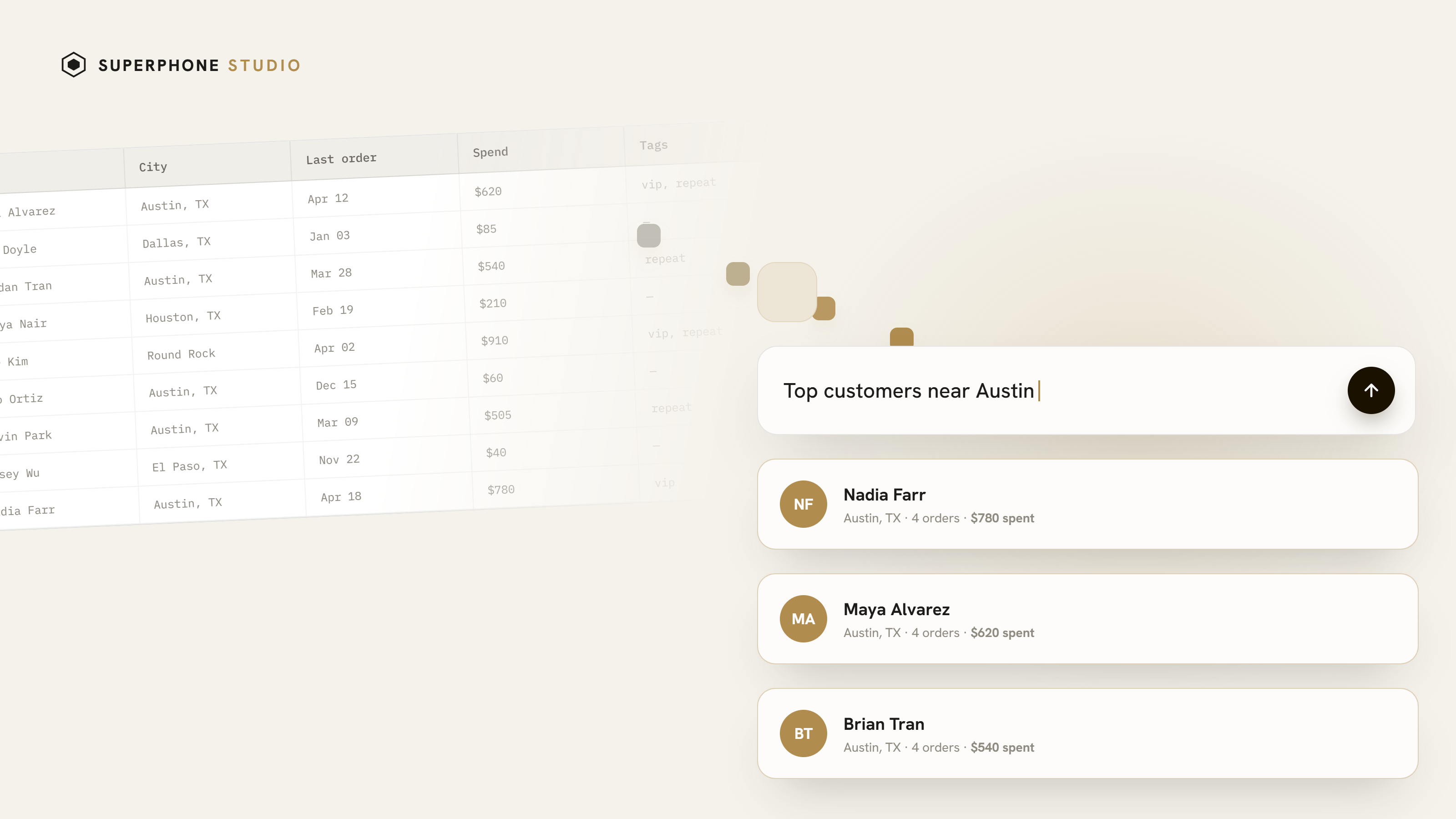
SuperPhone Studio: How to Find Your Best Customers Without Touching a Spreadsheet

Post author image
Rob Berberian
July 10, 2026

You know the moment. You want to send a targeted campaign to your best customers, so you open a CSV export, stare at 4,000 rows, and try to remember who bought your last three offers.

Ten minutes later, you give up and send the same message to everyone.

Most customer analytics tools were built for data analysts, not business owners trying to make quick, informed decisions.

AI changes that workflow. Instead of wrestling with columns and formulas, you ask a question in plain English. The system finds the right contacts, shows you how it interpreted your request, and gives you a list you can use immediately.

It is a faster way to see who is most valuable, who is slipping away, and who may be ready for your next offer.

How to Make Your Data Useful

AI customer segmentation groups customers based on behavior, such as what they bought, how much they spent, how recently they engaged, and how long it has been since their last purchase.

Traditional CRM filters can do this, but not without work.

The old process involved exports, columns, filters, cross-referencing activity, and rebuilding the same audience in another tool.

By the time you finish, the campaign feels like a chore before you have even written the message.

AI customer segmentation turns the work into a conversation. You can type:

Find contacts who spent more than $1,000 this year and have not heard from me in 60 days.

Or:

Show me customers who bought my first course but have not purchased my coaching program.

The system translates your request into filters, previews the results, and gives you a segment to review. You make the final call. You just do not have to build the logic from scratch.

The Three Customer Questions Most Businesses Can't Answer Fast Enough

You already know the questions that matter. The issue is that most tools make the answers too slow to find.

1. Who are my highest-value customers?

With hundreds or thousands of contacts, memory is not a reliable system.

Some of your best customers are quiet buyers who have purchased multiple offers. Others came in through an older campaign and have never been properly nurtured.

AI customer segmentation can surface those people by total spend, purchase frequency, lifetime value, or a combination of those signals. That matters because your most engaged and highest-spending customers deserve to hear about the next step before the rest of your list.

2. Who is about to churn?

Churn rarely arrives with a polite email explaining why someone is leaving. More often, it looks like silence.

A customer who bought three times last quarter stops opening messages. Someone who clicked every launch email does not engage for 60 days. Few teams catch those warning signs because nobody is reviewing every customer record manually.

With AI customer segmentation, you can ask for people who used to buy or engage regularly but have gone quiet. That gives you a chance to send a useful re-engagement message before the relationship disappears.

The goal is to notice the change soon enough to respond.

3. Who is ready for an upsell?

One of the most expensive marketing mistakes is giving the same pitch to everyone.

A new lead needs context. A customer who already bought your foundational offer may be ready for implementation support, a premium program, or a higher-touch service.

AI customer segmentation lets you find people who purchased your entry-level course, clicked recent promotional messages, replied in the last 90 days, and have not purchased your premium offer.

That is a much warmer segment than your full list, and it gives you a reason to write a relevant message.

Why Manual Segmentation Finally Broke

Manual segmentation breaks once the business grows.

Your list outgrew your memory. The customers you remember get attention, while quiet but valuable buyers fall through the cracks.

Your data is scattered. Revenue may live in Stripe. Conversations live in your SMS platform. Email engagement lives somewhere else. When those systems do not connect, every campaign becomes a scavenger hunt.

The workflow kills execution. Even after building the right segment, you still need to export contacts, format a file, upload it elsewhere, double-check the audience, and send. That is where good campaign ideas die.

The best segments are compound. Useful lists combine several signals:

Customers who spent more than $1,000, clicked a recent message, and have not bought in the last 90 days.

That can take real time to build manually. Conversational AI makes it practical for the person actually running the business.

What This Looks Like in Practice

It should feel like a capable assistant that understands your customer data and shows its work.

Here is the workflow inside a tool like SuperPhone Studio:

  1. Ask a question in plain English. For example, “Find contacts who bought my last course but not my coaching program.”
  2. Review the filters it creates. The platform translates your question into rules and shows you the conditions behind the segment. You can adjust the criteria before anything happens.
  3. Preview the matching contacts. Review the segment for buying patterns, exclusions, or customers you want to treat differently.
  4. Take action from the same workspace. Once the list is right, send an SMS campaign directly to the segment rather than exporting contacts and rebuilding the audience elsewhere.

AI should help you move faster. It should never quietly message customers or make decisions you did not review.

Book a Demo to Start Now→

The Upsell Campaign That Can Justify the Feature

This is where AI customer segmentation becomes more than a dashboard feature.

Say you are launching a premium offer for customers who have already bought from you and may be ready for a higher-level solution.

The old process requires purchase exports, sorting, engagement checks, a manual list, and another upload. It can take half a day.

With SuperPhone Studio, you can ask:

Find contacts who have spent more than $1,000 with me, are still actively engaging, and have not purchased a course in the last 30 days.

In seconds, you have a list of people more likely to understand the value of your next offer.

From there, write a message that sounds like it was meant for them. Acknowledge the progress they have made, explain who the next step is built for, and give them a direct invitation to reply or purchase.

This is not about squeezing every customer harder. It is about matching the offer to the customer stage. When someone has already shown trust through repeat purchases and engagement, a relevant upsell can feel useful rather than intrusive.

Better Segments = Better Customer Conversations

The value of AI customer segmentation is not only revenue. It is relevance.

You stop treating your list like one giant audience.

You can create smarter campaigns, such as a welcome sequence for new leads, a thank-you offer for repeat customers, a re-engagement check-in for people who went quiet, or a premium invitation for customers with high lifetime value.

That makes your marketing feel less like noise. Often, the strongest opportunity is not more leads. It is a clearer picture of the relationships you already have.

Final Thoughts

Many businesses have customer data they rarely use because getting to it feels like work nobody has time for.

AI customer segmentation closes that gap. It makes useful questions easier to ask, validate, and act on. When finding the right customers takes seconds instead of hours, you naturally make better use of the data you already paid to collect.

To see this workflow inside SuperPhone, visit:

Studio is a $20/month add-on built to help you turn customer data into targeted conversations and campaigns without touching a spreadsheet.

Subscribe to the SuperPhone newsletter for practical plays coaches, creators, and growing businesses can use to make their contact lists work harder.

Book a Demo to Start Now→

FAQs

1. What is SuperPhone Studio?

SuperPhone Studio uses natural language to organize your customer list based on behavior, spend, engagement, purchase history, and other available data. Describe the audience you want to find, then review the segment the system creates.

2. How is AI customer segmentation different from a regular SuperPhone filter?

A regular CRM filter requires manual field selection. AI customer segmentation lets you ask compound questions in plain English, preview the logic, and move into the next action, such as sending an SMS campaign.

3. Can SuperPhone Studio help with upsells?

Yes. It can help you identify customers who have already shown buying intent, such as repeat purchasers, high spenders, or people engaging with recent campaigns. You can then write a more relevant message instead of sending the same pitch to your entire list.

Post author image

Rob Berberian

COO

Drive revenue with personalized mobile messaging using SuperPhone

modal close icon

SuperPhone Studio: How to Find Your Best Customers Without Touching a Spreadsheet

Published Date: Jul 10, 2026

You know the moment. You want to send a targeted campaign to your best customers, so you open a CSV export, stare at 4,000 rows, and try to remember who bought your last three offers.

Ten minutes later, you give up and send the same message to everyone.

Most customer analytics tools were built for data analysts, not business owners trying to make quick, informed decisions.

AI changes that workflow. Instead of wrestling with columns and formulas, you ask a question in plain English. The system finds the right contacts, shows you how it interpreted your request, and gives you a list you can use immediately.

It is a faster way to see who is most valuable, who is slipping away, and who may be ready for your next offer.

How to Make Your Data Useful

AI customer segmentation groups customers based on behavior, such as what they bought, how much they spent, how recently they engaged, and how long it has been since their last purchase.

Traditional CRM filters can do this, but not without work.

The old process involved exports, columns, filters, cross-referencing activity, and rebuilding the same audience in another tool.

By the time you finish, the campaign feels like a chore before you have even written the message.

AI customer segmentation turns the work into a conversation. You can type:

Find contacts who spent more than $1,000 this year and have not heard from me in 60 days.

Or:

Show me customers who bought my first course but have not purchased my coaching program.

The system translates your request into filters, previews the results, and gives you a segment to review. You make the final call. You just do not have to build the logic from scratch.

The Three Customer Questions Most Businesses Can't Answer Fast Enough

You already know the questions that matter. The issue is that most tools make the answers too slow to find.

1. Who are my highest-value customers?

With hundreds or thousands of contacts, memory is not a reliable system.

Some of your best customers are quiet buyers who have purchased multiple offers. Others came in through an older campaign and have never been properly nurtured.

AI customer segmentation can surface those people by total spend, purchase frequency, lifetime value, or a combination of those signals. That matters because your most engaged and highest-spending customers deserve to hear about the next step before the rest of your list.

2. Who is about to churn?

Churn rarely arrives with a polite email explaining why someone is leaving. More often, it looks like silence.

A customer who bought three times last quarter stops opening messages. Someone who clicked every launch email does not engage for 60 days. Few teams catch those warning signs because nobody is reviewing every customer record manually.

With AI customer segmentation, you can ask for people who used to buy or engage regularly but have gone quiet. That gives you a chance to send a useful re-engagement message before the relationship disappears.

The goal is to notice the change soon enough to respond.

3. Who is ready for an upsell?

One of the most expensive marketing mistakes is giving the same pitch to everyone.

A new lead needs context. A customer who already bought your foundational offer may be ready for implementation support, a premium program, or a higher-touch service.

AI customer segmentation lets you find people who purchased your entry-level course, clicked recent promotional messages, replied in the last 90 days, and have not purchased your premium offer.

That is a much warmer segment than your full list, and it gives you a reason to write a relevant message.

Why Manual Segmentation Finally Broke

Manual segmentation breaks once the business grows.

Your list outgrew your memory. The customers you remember get attention, while quiet but valuable buyers fall through the cracks.

Your data is scattered. Revenue may live in Stripe. Conversations live in your SMS platform. Email engagement lives somewhere else. When those systems do not connect, every campaign becomes a scavenger hunt.

The workflow kills execution. Even after building the right segment, you still need to export contacts, format a file, upload it elsewhere, double-check the audience, and send. That is where good campaign ideas die.

The best segments are compound. Useful lists combine several signals:

Customers who spent more than $1,000, clicked a recent message, and have not bought in the last 90 days.

That can take real time to build manually. Conversational AI makes it practical for the person actually running the business.

What This Looks Like in Practice

It should feel like a capable assistant that understands your customer data and shows its work.

Here is the workflow inside a tool like SuperPhone Studio:

  1. Ask a question in plain English. For example, “Find contacts who bought my last course but not my coaching program.”
  2. Review the filters it creates. The platform translates your question into rules and shows you the conditions behind the segment. You can adjust the criteria before anything happens.
  3. Preview the matching contacts. Review the segment for buying patterns, exclusions, or customers you want to treat differently.
  4. Take action from the same workspace. Once the list is right, send an SMS campaign directly to the segment rather than exporting contacts and rebuilding the audience elsewhere.

AI should help you move faster. It should never quietly message customers or make decisions you did not review.

Book a Demo to Start Now→

The Upsell Campaign That Can Justify the Feature

This is where AI customer segmentation becomes more than a dashboard feature.

Say you are launching a premium offer for customers who have already bought from you and may be ready for a higher-level solution.

The old process requires purchase exports, sorting, engagement checks, a manual list, and another upload. It can take half a day.

With SuperPhone Studio, you can ask:

Find contacts who have spent more than $1,000 with me, are still actively engaging, and have not purchased a course in the last 30 days.

In seconds, you have a list of people more likely to understand the value of your next offer.

From there, write a message that sounds like it was meant for them. Acknowledge the progress they have made, explain who the next step is built for, and give them a direct invitation to reply or purchase.

This is not about squeezing every customer harder. It is about matching the offer to the customer stage. When someone has already shown trust through repeat purchases and engagement, a relevant upsell can feel useful rather than intrusive.

Better Segments = Better Customer Conversations

The value of AI customer segmentation is not only revenue. It is relevance.

You stop treating your list like one giant audience.

You can create smarter campaigns, such as a welcome sequence for new leads, a thank-you offer for repeat customers, a re-engagement check-in for people who went quiet, or a premium invitation for customers with high lifetime value.

That makes your marketing feel less like noise. Often, the strongest opportunity is not more leads. It is a clearer picture of the relationships you already have.

Final Thoughts

Many businesses have customer data they rarely use because getting to it feels like work nobody has time for.

AI customer segmentation closes that gap. It makes useful questions easier to ask, validate, and act on. When finding the right customers takes seconds instead of hours, you naturally make better use of the data you already paid to collect.

To see this workflow inside SuperPhone, visit:

Studio is a $20/month add-on built to help you turn customer data into targeted conversations and campaigns without touching a spreadsheet.

Subscribe to the SuperPhone newsletter for practical plays coaches, creators, and growing businesses can use to make their contact lists work harder.

Book a Demo to Start Now→

FAQs

1. What is SuperPhone Studio?

SuperPhone Studio uses natural language to organize your customer list based on behavior, spend, engagement, purchase history, and other available data. Describe the audience you want to find, then review the segment the system creates.

2. How is AI customer segmentation different from a regular SuperPhone filter?

A regular CRM filter requires manual field selection. AI customer segmentation lets you ask compound questions in plain English, preview the logic, and move into the next action, such as sending an SMS campaign.

3. Can SuperPhone Studio help with upsells?

Yes. It can help you identify customers who have already shown buying intent, such as repeat purchasers, high spenders, or people engaging with recent campaigns. You can then write a more relevant message instead of sending the same pitch to your entire list.

Related posts

all posts
No items found.

Get your number today

Setup your SuperPhone® today and start boosting your digital revenue through personalized mobile messaging.