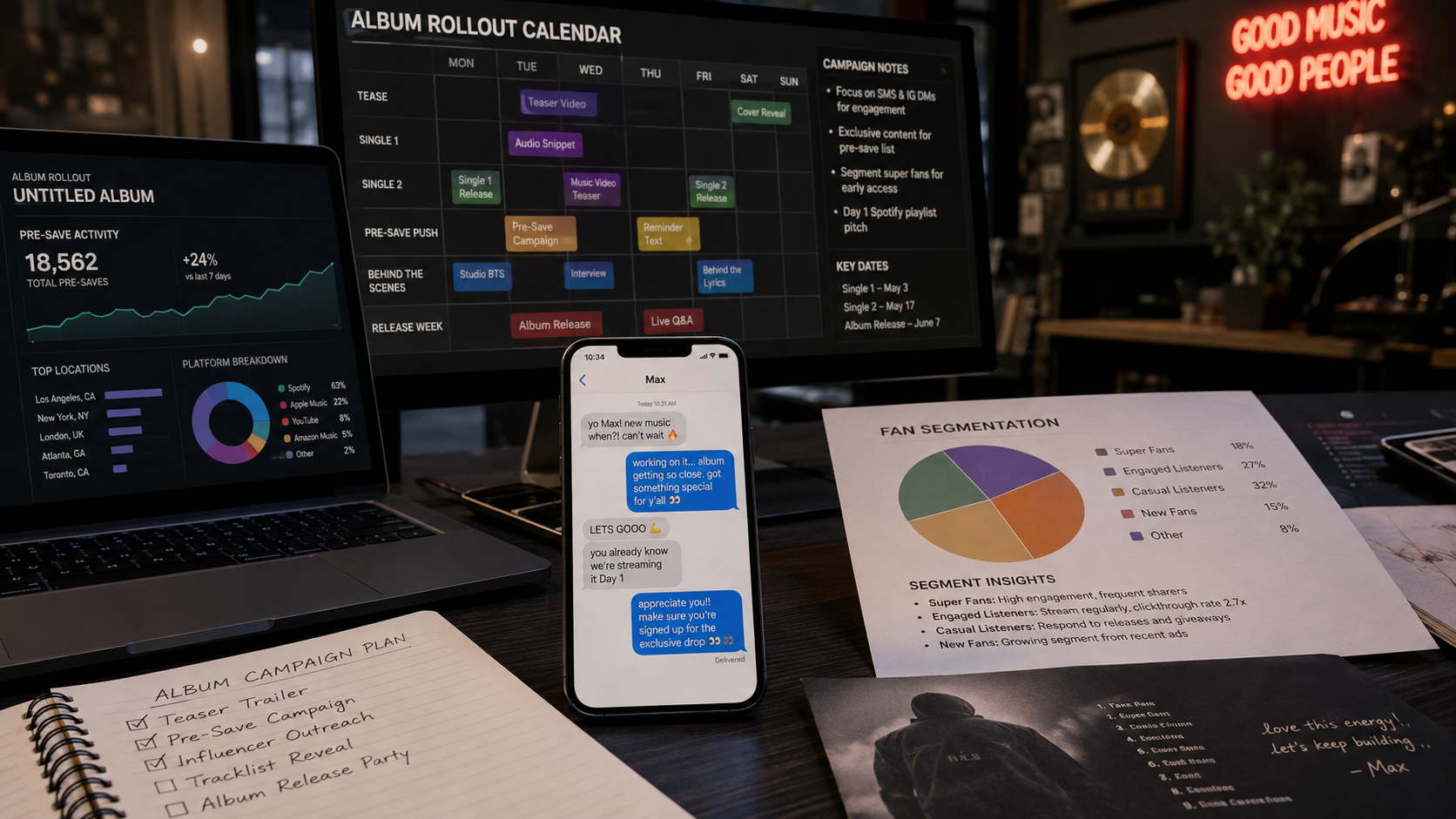
How Record Labels Use SMS Marketing During an Album Rollout
Social reach is useful, but record labels increasingly need direct access to the fans behind those numbers. Here’s

I remember when an album rollout basically meant radio, press, a music video, a few strategically timed interviews, and a lot of hoping fans showed up on release day.
That world looks very different now.
Today, a record label can work with an artist who has millions of followers and still have surprisingly little direct access to the actual people behind those numbers.
Instagram owns the Instagram audience. TikTok decides what gets distributed on TikTok. Streaming platforms know who listened, skipped, saved, and came back.
The artist usually knows far less about those people.
That's what makes SMS interesting for record labels and artist teams. It isn't another place to rack up followers. It's a direct-to-fan channel that can follow someone from the first album teaser to release day, merch, touring, and whatever the artist does next.
How Record Label SMS Marketing Fits Into an Album Rollout
Record label SMS marketing gives artists and their teams a direct communication channel with fans who have chosen to hear from them.
Instead of relying entirely on algorithms to distribute every announcement, labels can use SMS throughout an album campaign to build fan lists, tease releases, send pre-save links, announce tickets, promote merchandise, start conversations, and identify highly engaged fans.
The opportunity isn't simply getting more people to hear a song.
It's figuring out which listeners care enough to become something more.
That might be someone who pre-saves the album, buys vinyl, attends the tour, grabs limited merch, replies to the artist, or shows up again for the next release.
SMS gives the artist team a way to recognize those signals.
Social Media Builds Attention. SMS Builds a Direct Relationship.
Social media is still incredibly important for music marketing.
An artist shouldn't abandon TikTok because they collected some phone numbers.
The problem is ownership.
Imagine an artist has:
- 2 million Instagram followers
- 800,000 TikTok followers
- 3 million monthly listeners
- 75,000 SMS subscribers
At first glance, 75,000 looks like the smallest audience.
But ask a different question:
Which audience can the artist actually contact directly?
That's where those 75,000 people become much more interesting.
The artist team can communicate with them directly, segment the audience, see who engages with campaigns, understand location and interests, and continue building those relationships across multiple releases.
The goal isn't SMS instead of social.
It's using social media to create attention, then giving the most engaged fans a way to get closer.
SuperPhone has already been used this way in artist campaigns. The Miley Cyrus SuperPhone campaign combined social promotion, a dedicated hotline, fan segmentation, direct messaging, ticket promotion, and merchandise retargeting around a major release.
That's the bigger opportunity.
Not another audience rented from another platform.
A direct fan channel the artist can keep building.
Phase 1: Build the Fan List Before You Announce the Album
One of the biggest mistakes businesses make with SMS is waiting until they have something to sell before building the list.
Music teams shouldn't make that mistake either.
The strongest time to grow an artist's SMS audience may actually be before the album is officially announced.
Give fans a reason to text.
For example:
Text "ALBUM" to get something tomorrow before I post it anywhere else.
Or:
I have something I'm not putting on Instagram. Text me.
Now curiosity is doing the acquisition work.
The incentive could be:
- Unreleased artwork
- A voice note from the artist
- An album teaser
- Early tour dates
- A private video
- A song snippet
- Early merchandise access
- Behind-the-scenes content
The important part is positioning.
Don't market it like another newsletter.
Fans aren't asking for another promotional list to join.
They want access.
We've seen this work in different forms with artists using SuperPhone. In one music release campaign with UK artist Jaykae, fans were encouraged to call and text to hear exclusive previews and participate in the release experience.
The phone itself became part of the campaign.
Phase 2: Turn the Album Announcement Into a Conversation
Here's where SMS gets more interesting than another announcement channel.
The album announcement doesn't have to be one giant blast saying:
NEW ALBUM OUT OCTOBER 17. PRE-SAVE HERE.
You can send that.
But you're leaving one of SMS's biggest advantages on the table.
People can reply.
Imagine the artist sends:
It's finally happening. Album October 17. Want to see the cover?
Fans reply YES.
Then the cover arrives.
A few days later:
What do you want next? Tracklist or another snippet?
Now the team isn't simply distributing album information.
You're collecting intent.
Someone who replies to three album messages is behaving differently from someone who hasn't interacted in six months.
That difference matters.
Phase 3: Stop Treating Every Fan Like the Same Fan
This is probably the part of SMS marketing that gets overlooked the most.
A label shouldn't necessarily send every campaign to every person on the list.
Imagine you've collected 300,000 phone numbers.
Inside that audience, you might have:
- Highly engaged fans: Give them early album access or a limited merch opportunity.
- Previous merch buyers: Promote vinyl, bundles, signed products, or exclusive drops.
- New York fans: Send the NYC listening party or concert announcement.
- Los Angeles fans: Send the LA pop-up or event.
- Fans who clicked the pre-save: Send the release-day reminder.
- Fans who replied to album teasers: Give them more behind-the-scenes content.
- Inactive fans: Run a separate re-engagement campaign.
- VIP or superfan segment: Offer early tickets, exclusives, or private experiences.
That's where SuperPhone's direct fan engagement approach becomes much more than sending a mass text.
The list starts becoming audience intelligence.
Instead of:
Who can we message?
the question becomes:
Who should receive this message?
That's a much better marketing question.
Phase 4: Use SMS for Pre-Saves Without Sending the Same Link Four Times
Pre-save campaigns are an obvious use case for SMS.
But there's a difference between reminding someone and hammering them.
I'd rather build a sequence.
Message 1: The Announcement
Tell the story.
Why does this album matter? What's different? Why should someone care?
Message 2: The Pre-Save
Now send the actual pre-save opportunity.
Keep the action obvious.
Message 3: Something Exclusive
Reward people who are paying attention with artwork, a song snippet, a voice note, video, lyric, or story behind the album.
Message 4: The Release Reminder
Bring people back when the project actually drops.
Now the SMS campaign has a narrative.
You're not sending the same link four times.
You're giving fans different reasons to stay engaged.
Phase 5: Make Release Day Feel Like an Event
Release day is where every channel should work together.
Social.
Email.
Streaming.
Creators.
Press.
Paid media.
SMS.
The advantage of SMS is immediacy and conversation.
Instead of simply texting:
THE ALBUM IS OUT.
Give fans some context.
We worked on this album for two years and it's finally yours. Start with track 4. Then text me what you think.
That last sentence changes the campaign.
Text me what you think.
Now release day produces conversations, not only clicks.
And those conversations can influence what happens next.
Phase 6: Let Fan Responses Shape the Next Campaign
Imagine thousands of fans respond during release week.
Those replies contain useful signals.
Fans might tell you:
- Their favorite songs
- Their favorite lyrics
- What city they're in
- Whether they want tour information
- Whether they bought merchandise
- Which song surprised them
- Whether they attended a previous show
Now the artist team has information it can actually use.
If thousands of fans keep mentioning track seven, maybe track seven deserves more creative.
If fans in Chicago are disproportionately engaged, maybe that audience gets prioritized around an upcoming show.
If someone bought merchandise during the last release and consistently replies to messages, that person probably belongs in a different fan segment than someone who hasn't opened anything in months.
SMS becomes a listening channel as much as a distribution channel.
Phase 7: Add Voice to Make the Campaign Feel Bigger
Text doesn't have to be the only direct-to-fan experience.
For artists, voice can make the phone number itself part of the creative.
An artist could invite fans to call and:
- Hear an unreleased song snippet
- Listen to a personal voice message
- Choose between different tracks
- Hear clues about an upcoming announcement
- Leave a voicemail for the artist
- Access different audio experiences through keypad prompts
SuperPhone's IVR and voice capabilities are designed for this kind of campaign, including call-in experiences, personalized audio, incoming and outgoing calls, and interactive voice sequences.
This is where the campaign starts feeling less like "SMS marketing" and more like an artist experience.
The phone number becomes part of the rollout itself.
Phase 8: Connect the Album to Merchandise
The album shouldn't live in one marketing silo while merchandise lives in another.
Your most engaged listeners are often the exact people most interested in physical products.
That might include:
- Vinyl
- Signed CDs
- Apparel
- Posters
- Limited editions
- Bundles
- Anniversary products
Segmentation matters again here.
Someone who purchased three previous vinyl releases should probably receive a different message from someone who joined the list yesterday.
A casual listener may stream the album.
A highly engaged fan might stream the album, buy vinyl, purchase merchandise, attend a show, join an experience, and participate in the next release.
The goal isn't squeezing every possible dollar out of the fan.
It's recognizing the people who genuinely want deeper participation and giving them opportunities to participate.
Phase 9: Turn Album Engagement Into Ticket Sales
The album campaign eventually becomes the tour campaign.
Suddenly one piece of fan information becomes extremely valuable:
Location.
Suppose the artist announces 25 dates.
Sending all 25 dates to everybody isn't particularly useful.
Instead:
Chicago. We're coming October 22. Want the presale code before tickets go public?
That feels relevant because it is relevant.
Geographic segmentation connects digital fan engagement with physical events.
SuperPhone's Miley Cyrus case study is a good example of this. Her team used segmentation and geo-targeting to communicate with fans around tour dates, then used the same direct channel again for merchandise.
And every campaign creates another signal.
Now the team knows who:
- Clicked
- Requested information
- Responded
- Purchased
- Showed interest in a specific city
The fan profile gets richer over time.
Phase 10: Don't Let the SMS List Die After Release Week
This is the part I'd pay the most attention to.
An album campaign might last several months.
A fan relationship could last decades.
Great music marketing isn't only about maximizing one release.
It's about compounding audience relationships across releases.
If an artist collects 100,000 opted-in fans during one album cycle, those people don't disappear when the next project starts.
The next campaign begins with an audience.
Then that audience grows again.
Eventually you aren't starting every album rollout from zero.
That's when direct-to-fan marketing becomes an asset instead of another campaign expense.
What an SMS Album Rollout Could Look Like
None of this means the label needs to text fans every day for two months.
The rollout should follow the rhythm of the project.
Here's a simple framework for how SMS could support the campaign from the first teaser through the next release.
SMS Should Feel Like the Artist, Not the Marketing Department
This may be the most important rule in the entire article.
If an artist's Instagram sounds like them, their text messages should too.
Fans can tell when something suddenly sounds like it went through twelve layers of corporate approval.
Compare:
The new album is now available on all streaming platforms. Listen today.
with:
It's yours. Start with track 6 and text me when you figure out why I told you that.
Same album.
Very different experience.
One is advertising.
The other creates curiosity.
The strongest SMS campaigns don't feel like SMS marketing.
They feel like someone texted you.
Connect SMS With the Rest of the Artist's Marketing Stack
SMS doesn't need to live on an island.
Fan information can come from landing pages, forms, ecommerce purchases, lead-generation campaigns, membership platforms, and other systems already being used by the artist or label.
SuperPhone offers integrations with marketing, ecommerce, CRM, form, and website tools, which can help teams connect existing audience data with their SMS strategy.
This matters because the more context you have around the fan, the better the message can become.
A fan who bought vinyl shouldn't always receive the same campaign as someone who entered through a giveaway.
A concert buyer shouldn't necessarily receive the same message as someone who only engages with digital releases.
The technology should help make the communication feel more human, not less.
Don't Abuse the Direct Channel
Direct access to someone's phone is valuable precisely because people protect it.
Treat it accordingly.
Fans should knowingly opt in to receive messages, receive the type of communication they expected, and have a clear way to stop receiving messages.
But there's also a simpler rule:
If fans regret giving you their number, the strategy failed.
Sending more isn't the goal.
Sending something worth receiving is.
Protect the channel.
Where SuperPhone Fits Into Direct-to-Fan Marketing
SuperPhone was built around a simple idea:
A phone number shouldn't just represent another subscriber. It should represent a relationship.
For labels and artist teams, that means using SMS to do much more than send release links.
You can build direct fan lists, segment audiences, run campaigns, have two-way conversations, create call-in experiences, understand engagement, and keep learning about the audience over time.
You can see more examples across the SuperPhone artist and brand case studies.
This becomes particularly interesting when an artist already has hundreds of thousands or millions of followers scattered across platforms but wants a direct channel to the people who care most.
The question changes from:
How many followers does this artist have?
to:
How many fans can this artist actually reach, understand, and build a relationship with?
That's a much more valuable question.
Closing Thoughts
I've spent enough time around SMS to know that sending more messages isn't the interesting part.
Knowing who you're talking to is.
Record labels already have powerful distribution machines. Social platforms can create global attention overnight. Streaming gives artists access to audiences previous generations couldn't have imagined.
SMS adds something different.
A direct relationship.
For an album rollout, that relationship can begin with a teaser, turn into a pre-save, become a release-day conversation, lead to merchandise or tickets, and still exist when the next album begins.
That's the part worth building.
If you're planning an upcoming artist release, see how SuperPhone can help you build a direct-to-fan channel that lasts beyond release day.
Frequently Asked Questions
1. How Can Record Labels Use SMS Marketing?
Record labels can use SMS marketing to build opted-in fan lists, announce releases, distribute pre-save links, promote merchandise and tickets, collect fan responses, and segment audiences based on engagement. The biggest advantage is creating a direct communication channel that can continue across multiple releases instead of rebuilding the audience every time.
2. Is SMS Marketing Useful for Independent Artists Too?
Yes. An independent artist doesn't need hundreds of thousands of contacts for SMS to be useful. A smaller group of highly engaged fans can support release announcements, merch drops, ticket sales, listening parties, crowdfunding, and long-term direct-to-fan growth.
3. When Should an Artist Start SMS Marketing for an Album Rollout?
Ideally, start building the SMS list before the album announcement rather than waiting until release week. Early access, exclusive snippets, voice notes, behind-the-scenes content, and private announcements give fans a reason to join before the promotional cycle becomes crowded.


Drive revenue with personalized mobile messaging using SuperPhone